Saturday, September 17, 2011

Rejoice Always


But the Comforter, [which is] the Holy Ghost, whom the Father will send in my name, he shall teach you all things, and bring all things to your remembrance, whatsoever I have said unto you. John 14:26

The early morning sun shines brightly as I re-read the Bible verses in front of me. Several months ago I had memorized the verses 1 Thes 5:16-18, but it’s not until now that the Spirit speaks to me through these verses.

“Rejoice always, pray without ceasing, in everything give thanks for this is the will of God in Christ Jesus for you.”

Does this mean as believers and followers of Christ we are promised happiness here on earth? Happiness that will allow us to rejoice always? On the contrary Jesus tells his followers specifically in John 16:33 that; In the world you will have tribulation.

The dictionary defines tribulation as: Great affliction, trial, or distress; suffering:

So why and how are we to rejoice always? Because, as John 16:33 continues, “be of good cheer, I (Jesus) have overcome the world.

We can rejoice because of what Jesus has done.

Imagine, you are a mother or father and see your child struggle tremendously. You feel for him, because you have experienced the same, (Jesus lived on earth and was a man of sorrows and acquainted with grief, Isaiah 53). But even as you see your child struggle you encourage him to rejoice because you know that there is an end in sight, an end to all suffering and pain, an end where sorrow will be turned to joy.

Our heavenly Father does the same. He encourages us to rejoice because; The sufferings of this present time are not worthy to be compared to the glory which shall be revealed in us. And Romans 8:18 Eye hath not seen, nor ear heard, neither have entered into the heart of man, the things which God hath prepared for them that love him. 1 Cor 2:9

Jesus says in John 16:20 Verily, verily, I say unto you, That ye shall weep and lament, but the world shall rejoice: and ye shall be sorrowful, but your sorrow shall be turned into joy. 21 A woman when she is in travail hath sorrow, because her hour is come : but as soon as she is delivered of the child, she remembereth no more the anguish, for joy that a man is born into the world. 22 And ye now therefore have sorrow: but I will see you again, and your heart shall rejoice , and your joy no man taketh from you.

Giving birth is a painful experience, but so great is the joy when you hold the new born baby in your arms, you don`t remember the pain anymore. That is the analogy Jesus uses between life and eternity. Life is painful, but so great is the joy when you begin eternity with God you no longer remember the pain.

During struggles and trials how often do we focus on the temporal life here? In Col 3:2 it says “Set your mind on things above, not on things that are on the earth.”

Jesus tells us in John 14:1-4 Let not your heart be troubled; you believe in God, believe also in me. In my father`s house are many mansions; if it were not so, I would have told you. I go to prepare a place for you, I will come again and receive you to myself; that where I am, there you may be also.

Jesus promises believers that he is preparing a place for them. A glorious, eternal home where all tears will be wiped from their eyes. (Revelations 21:4) While we wait for his return he has promised that; I will be with you always, even until the end of the world. Matt 28:20.

Rejoice in the Lord always: and again I say, Rejoice Phil 4:4

Because of what He has done, we have reason to rejoice. My lips shall greatly rejoice when I sing unto thee and my soul which thou hast redeemed. Psalm 71:23

Wednesday, September 14, 2011

Working Days..

Tuesday, September 6, 2011

“Hey Will, tomorrow I won’t be flying because the airplanes are going in for inspections, do you want to come to work with me and help me figure out a problem with our EDH (city power) bills? This issue with the extra charge on our account has been dragging on for months and its one big headache! Maybe your past experience at the accounting office can help us figure out what is going on.”

“What about Jayden?”

“We can take him along. Just bring books and crayons and activities. We’ll have a family work day.”

“Okay, sounds good!”

Wednesday, 6:00 a.m. September 7, 2011

“Come on Jayden! You have to wake up! We’re going to work with Daddy!”


The groggy boy refuses to comply so I finally pick him up and deposit him on the couch in the playroom.

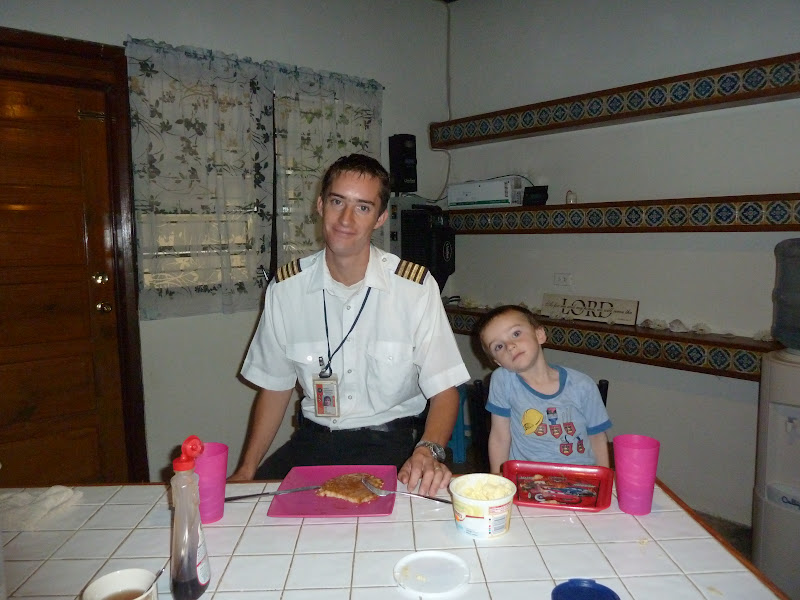
With no milk for cereal, or bread for toast, I quickly whip up a batch of pancakes. Brushing on butter and syrup I ready three plates.

“Jason, Jayden time to eat!”

Still half asleep Jayden slowly makes his way to the kitchen, rubbing his eyes and yawning.

“You have to hurry Jayden, we’re going to work with Daddy!”

“Okay, Mom!”

After praying together we dig in. The pancakes are delicious!


When breakfast is finished and the dishes are cleared away we head to the truck for a ride to the airport. Since it’s before 7:00 a.m. the roads are still fairly quiet.


It doesn’t take long before we arrive at the domestic terminal. In the office Christine is already working, as she’s the new MAF scheduler.

I spend a few minutes chatting with her before getting Jayden set up at an empty desk with coloring books and felts.

Then I pull up an office chair beside my husband and get to work sorting through stacks of paperwork.

Every few minutes I lean over to chat and joke with him. Working together at a desk brings back memories of our college days. Just like back then, I’m still a pretty good distraction, and I notice he doesn’t get that much work done on the sheets he’s filling out.

Since all the bills are in French and each month all the MAF family bills are paid with one cheque it takes some sorting and organizing before I pinpoint the problem. Once I have the problem figured out, I organize all the paperwork into one file.

“It looks like we’ll have to take a trip to the EDH office,” I tell Jason.

“Gregory, the accountant, has tried that already with no success, so maybe you need to go along.”

“Alright, let’s plan a day for next week then.”

I find Gregory and Diecon, the MAF driver, and we decide on next week Tuesday morning.

“I’ll leave Jayden with Denise, since I don’t know how long it will take,” I tell them and they nod.

“See you next week!” They bid their goodbyes, and since our work is finished, Jayden and I pack up our backpacks to go back home.

“I kind of liked the whole pushing paper thing,” I tell Jason. “Maybe, I’ll have to come more often.”

Amused he smiles and shakes his head.

“You mean you don’t like working with us?” I ask incredulously. Still grinning, he gives us both a quick hug. “See you at home later!”

Tuesday, September 13, 2011

Early morning sunshine filters through the windows as I pull a fresh banana loaf out of the oven. Having no other snacks in the house, I decided that banana loaf would be the perfect treat to take to the office, share with the guys and munch on, while I wait for who knows how long at the EDH office! Nothing in Haiti is ever easy, and part of me dreads spending a day explaining a complex problem in a second language.


At 8:30 I kiss Jayden goodbye, give last minute instructions to Denise and hop in the MAF truck. Anoud opens the gate and I slowly back out. At the end of our street, I check my purse only to realize I forgot my cell phone.

Should I worry about going back to get it? Yup, I better. Slowly backing up I park the truck in front of our house as Anoud unlocks the small door in the gate. Always protective of us, he makes sure the truck is out of sight before going back to work.

I thank him and then run inside to search the house for the phone. Not finding it in any of the usual places I finally find it in a side pocket of a different purse. Pulling it out, I run back to the truck and wave goodbye to Anoud. Now to remember how to get to the airport.

Since the main roads are too busy I now take the back roads, and thankfully find my way without a single wrong turn. At this time of day it takes 30 minutes instead of 15 to get to the airport. Parking the truck in the mud parking area I grimace. How am I going to walk through that? Stepping out of the truck I lock the doors and feel squishy mud sucking at my feet. Glad I decided not to wear my customary flip flops, I gingerly make my way to the paved road. With heavy rains every night the city is full of this oozing, nasty mud.

At the main paved road I stomp my feet to try to get the mud off but it stubbornly clings to my black shoes. Oh, well, nothing I can do about it, I decide, as I make my way to airport security.

I stop to put my big purse through the scanner and then carrying my water bottle I walk through the malfunctioning metal detector. Just as I’m ready to pull my purse back off the belt on the other side, a security officer stops me.

“Do you have a fork in your purse?” He asks in Creole.

“Yes.” I reply.

“You need to give that to me Madam!”

“My tiny desert fork?”

“Yes, Madam, it can be used as a weapon.”

“Excuse me Sir, but I have a little baby in my stomach, so I need to eat!” I reply, pointing to my barely visible four month baby bump.

“Sorry Madam!”

“I’m not giving you my fork Sir!” I reply, refusing to lose this battle.” It belongs to a set my Mom bought me for my wedding!”

Seeing my determined expression, he wavers.

“Are you with MAF?”

“Yes sir.” I reply.

“Alright then, just go.”

Smiling triumphantly I pick up my purse and continue on my way. Meeting Jason in the terminal, I can’t help but tease him. “I guess its okay to attack MAF pilots with desert forks!” I joke, telling him of the little episode. Laughingly he shakes his head.

“On a more serious note, a friend of ours is here,” he says, pointing to the waiting area. “He was in a head on collision with a car while driving his motor bike up the road to the Baptist mission. A vehicle was passing on a blind corner and ran right into him.”

“Oh no.”

I walk over to see Stan in a wheel chair with one full leg cast, a banged up knee, and abrasions on his hands and arms. After talking to him for a few minutes he tells us that thankfully he has no head injuries. “The Doctors here are concerned about my chest pains and low blood pressure though, so MAF will fly me to Pignon where Missionary Flights International will pick me up and take me to Florida.“

Expressing our concern and regret we spend some more time talking to him and his parents.

When Gregory and Diecon show up I bid Jason and Stan goodbye and make my way back to the truck.

“Do you want to drive?” Diecon asks.

“I don’t know where the office is so you go ahead.”

“Okay.”

All three of us hop in the truck and off we go. Since both Gregory and Diecon speak English, conversation now flows mostly in English with a few Creole words thrown in. Always wanting to learn more about Haitian culture, I ask questions about family, children and marriage. I learn that men can marry at any age without social pressures whereas women are pressured to be married before age 30. I also learn that although traditionally Haitians had large families, many young Haitians now have small families, 2 or 3 children, so they can provide better for their children and give them good educations. I learn that it’s normal for children to start school at the age of 2, since most schooling is in French and at that age, children learn the language quicker. We go on to talk about driving in Haiti and the process of gaining a Driver’s license.

“Did you know that some people purchase a drivers license in Haiti without a single test or lesson?” Diecon asks.

“I certainly did not! Are you serious?”

“Yup, many people don't want to deal with the hassle of getting a license at a driving school because of the exams, cost of renting a vehicle, and paying large sums for an instructor. Taking a road test in crazy Port au Prince traffic can be a nightmare too, so they chose to avoid this by finding someone at the license office who will make a Driver's license for them; for a price of course. “

“Wow, that’s a scary thought!”

Diecon and Gregrory just shrug. “That’s life here. You can do almost anything if you have some money and know the right people.”

My cultural lesson ends at that moment as we pull into what looks like a deserted scrap yard.

“Umm Diecon, I don’t see any EDH office! You aren’t secretly kidnapping me are you?” I joke.

He laughs. “Nope. This is the EDH scrap yard. We have to drive through it to get to the office.”

“Okay then. “

Holding the thick file folder in one hand and balancing my over sized purse in the other we make our way to the front entrance. Inside it seems like a slow day as many people are sitting behind their desks doing nothing. We walk up to a man with a computer who is working and he motions for us to sit down. Gregory explains the problem and after scanning through the paperwork and scratching his head he beckons for us to follow him. We make our way up a flight of stairs. First into one office and then into the next. This goes on for about 15 minutes till we are lead downstairs again to the initial office.

Feeling a little useless as Gregory and Diecon do all the talking I realize my main purpose here is my skin color. Being white means I must be important, and pretty soon more and more people are ‘put on the case.’ I feel a little awkward just being viewed as important because of my skin color, but at least it looks like some progress is being made.

I guess I just have to learn to accept the fact that skin color matters here, I think to myself. It means I have to pay more for fruits and vegetables at the outdoor markets and I’ll have more people ask me for money on the streets, but it also means I get helped quicker in situations like this. It feels wrong, but there’s nothing I can really do about it.

Back in the main office a lady prints out statements from each family showing what happened with the payments. Now with this information we can fix the problem internally. Looking at the metal beams holding up the ceiling tiles at awkward angles I’m a little glad that it doesn’t take long for the printouts to be made. This multi-storey building does not appear to be very earthquake safe.

Knowing it’s useless to think that way, as our times and lives are in God’s hands, I shake my head to clear those thoughts as I follow Gregory and Diecon outside into the warm Caribbean sunshine. Walking back to the truck I thank God again for answering my prayers and resolving the EDH paperwork issues.

My working days, for now, are over.

Thursday, September 8, 2011

The Living Word

"Jason, Jason!" Stepping out of the airplane I see an excited Djempsky and two of his friends waving at me from the edge of the airstrip.

"Map vini!" (I'm coming) I tell them and then proceed to unload cargo and passengers. When I'm finished I make my way over to the boys and greet them in Creole.

Djempsky pulls out one of the many Haitian Creole Bible Verse Coloring Books that we have distributed, and shows me that he has colored all the pages. Then he begins to recite all the verses to me.


I am astonished since there are at least two dozen pages in it: the ten commandments; verses about sin and that all have come short of the glory of God; verses saying that Jesus Christ came into the world to save sinners and that he died on the cross and rose again. I continue to listen as he recites Bible verses about eternal life through faith in Jesus and that we are saved through grace alone.

"That’s great," I say, "but what are you going to do now? That’s the only Creole coloring book I have."

Djempsky smiles, and points to his two friends. "Well, I’m going to teach him. And then I’m going to teach him."

I take a moment to study their faces. How amazing it is to see young boys with such a passion to learn God’s word and teach others. God’s word is indeed powerful and alive.

Click on the 'Bible Verse Coloring Books' on the side bar to learn more about how you can help to spread God's Word.

Monday, August 29, 2011

Attacked!

Saturday, August 27

I look up at the cloudless sky as the warm Caribbean sun steadily climbs higher. The soft breeze and gentle call of the birds give no indication of what today will bring.

It’s 9:00 a.m. and I’m readying the 206, HH FLY, for a charter flight to Pignon. Feeling my cell phone vibrate at my side, I reach down to check the caller ID and notice it’s Lefils, our airstrip agent in LaGonave.

After the customary ‘Bonjou. Koman ou ye?’ Lefils tells me about a serious motorcycle accident that just happened. “Is it possible for you to do a medivac flight and transport two patients to the hospital in Port au Prince?” He asks, switching over to English.

Since my Pignon passengers are already waiting, I tell him that I’ll head over as soon as I’ve dropped them off. "Great! We’ll be waiting for you.” He says, before hanging up.

Since the 206 only has room for one stretcher, I slide it in the side of the plane and then load the passengers and cargo for Pignon. After a 25 minute flight, I land on the grassy Pignon strip and unload the passengers and cargo.
Now off to Lagonave.

The uneventful thirty minute flight from Pignon to Lagonave gives no hint of the danger I’ll soon be in. Even the sometimes stormy Caribbean ocean, parallel to the sandy La Gonave runway, is idyllic and peaceful today.

Down on the ground, the peaceful scene changes to something more chaotic as a massive crowd waits to watch the medical evacuation. Once the airplane engine is turned off, a pickup truck slowly advances closer. Hopping out of the airplane I quickly spot the two seriously injured, unconscious patients in the back. With the help of several bystanders we load the first patient onto the spine board and carefully place him in the aircraft. Since we have only one spine board I secure the second patient using two cargo straps and three seat belts. His head is swollen and there is a deep gash in his left temple.

Once both patients are secure, a third, smaller, middle aged man asks if he can travel with me to accompany the patients. I direct him to the co-pilot seat and then proceed to help him with his seat belt.

With both patients unconscious in the rear of the aircraft I now focus my attention completely on takeoff and flight.

Not even five minutes later disaster strikes. The second patient wakes up and thrashes around in the rear of the aircraft. Within minutes he has managed to undo the cargo straps and seat belts that were keeping him safe.

“Talk to him,” I instruct the man beside me in Creole and he tries his best to calm the patient. Disoriented and confused due to his head injury the patient begins to scream and yell and then frantically tries to open the cargo door at the back of the airplane. Looking back I watch in horror as he manages to unlock the door and cracks it open.

“PA FE SA!” I yell, and momentarily stunned he stops. Thankfully the outside wind force is strong enough to push the door back closed, but it remains unlocked.

“You need to get in the back and restrain the passenger,” I tell the man beside me, and he nervously fumbles with his seat belt.

Checking my instruments and making sure I’m on course I miss the enraged expression of the patient in the back. Suddenly a seat belt is wrapped around my neck from behind and twisted viciously. I let out a yell and then instinctively twist and punch. Feeling the seat belt loosen around my throat, I turn to see the man gingerly cupping his jaw.

“Get in the back now,” I tell the frightened man beside me. “Sit on him if you have too, but you need to restrain him before he gets worse and causes our airplane to crash!”

The fear of crashing is enough to propel the timid man into action and I watch as he climbs between the seats. Although much smaller than the patient, his fear of death empowers him to wrestle down the man.

Praying for calm, I remain focused on flying, checking back occasionally on the two men behind me, two men engaged in a life and death struggle.

Spotting the Port au Prince runway in front of me, I breathe a sigh of relief and thanks. Whispering a prayer of thanks to God, I focus on executing a safe landing.

Back at the MAF hanger, the Red Cross is waiting with their ambulance and quickly sedate the man.

Looking up at the azure heavens I marvel at how peaceful they still appear. Feeling a welcoming breeze brush my face I’m reminded that, regardless of the circumstances I may find myself in, my Father in Heaven is everywhere present.

Tuesday, August 23, 2011

Village Visit (part II) by Esther Krul

It’s nine o’clock Saturday morning and Will and Jayden have just arrived at Pastor Caleb’s house in Pignon. After a quick breakfast, Will, Jayden, a friend named Joe, and I are off to the market.

The bumpy roads quickly remind me that ‘this is Haiti’. After a ten minute drive we’re at the market and ready to buy the food for the food distribution this afternoon. Stepping out of the vehicle, the sound of a thousand peoples’ voices mingling with the sticky air overwhelms me.

Horses, donkeys, ducks, and chickens are all over the place and we need to watch where we step. Pushing through the masses of people I see vendors everywhere selling fruits, vegetables, rice, pastas and many other types of food; some which I don’t recognize.

It doesn’t take long before the crowd around us thickens as ‘blan’ in the market isn’t an everyday occurrence. Other then the curious stares, people are friendly and we smile back at them. Since the bulk of our money is for purchasing rice and beans we decide to do that first.

Joe, who is Haitian, can get a better price if he’s not seen with us, so Will counts out the correct amount of money and we separate from him. Ten minutes later, Joe returns with a huge sack of rice, and later another huge sack of beans. We load it into the vehicle, lock it and then go on the lookout for bouillon cubes (a popular Haitian seasoning), garlic cloves, juice powder packages, and treats for the children.

Rather than buying from the bigger vendors, Will decides to help some of the smaller ones and goes around making purchases all over the place. Speaking Creole, she jokes and laughs with the sellers before purchasing anything since relationships are very important in the bargaining process.


As we go from vendor to vendor we pass the meat department and I cringe. Dead animal parts lie on tables covered with flies.

Boiling pots of animal intestines fill the air with their unsavory scent.

By one table, chickens run around franticly trying to escape their death sentence. Cute little gloats bleat in horror at the thought of their imminent demise. Right then and there I decide to look no further.

Squelching my queasiness, we continue purchasing everything we need. Some vendors, not realizing how well Will can understand and speak Creole, try to overcharge us, but she quickly wins them over with her easy smile and kind words.

An hour later, with a very complaining Jayden in tow, who by now is hot, irritable, thirsty, and tired of people touching his skin and staring, we make our way back to the vehicle. Driving back to Pastor Caleb’s house I wipe the sweat from my face. That was quite the experience!


Back at the house, Will and I quickly get to work dividing the rice and beans into separate bags and adding the garlic and bullion.

When we are finished we sit back and take a rest.

“What a morning!” We say to each other.

At 1:00 p.m. Jason flies in and after a delicious lunch of rice and beans and fresh mango we load all the food into the vehicle and head to the camp for the distribution.

As we drive up to ‘Can De Le Gras,’ where Jason, Will and Jayden lived for three months for language and cultural study, we hear children signing.

I smile; it feels good to be here in Pignon, and it feels good be able to help the people here. I hop out of the car and the coolness of the air feels refreshing. I peer up into the sky and see threatening dark clouds surrounding the village. Just then the first rain drops begin to fall. We quickly unload the food, coloring books, and crayons and run under the gazebo for shelter from the falling rain.

Under the gazebo are two large tables. Sitting around the tables on chairs are about 50 children, half boys and half girls. Under the direction of John, a Haitian friend of Will and Jason’s, each child sits quietly waiting for the distribution to begin.

Before we start, they sing a few more Haitian hymns for us and it’s really special to listen too. Then one by one, in exemplary fashion they come up to collect their coloring book, crayons and crackers. “Merci” they thank me politely and after finding out how to say ‘you’re welcome’ I respond with a cheerful “Pa dekwa”.


As I hand out the items I study the children. Even with their clean faces and cute hairdos, I can see their poverty in their threadbare clothes and tattered shoes. Even the little hair bows can’t hide the orange tinge of malnutrition in some of the girls’ hair.

When we’ve finished handing out the coloring books, crayons and crackers we hand out bags of food to each child.

One child impulsively hugs me as I give her the food and my heart breaks. To be so thankful just to be able to take home food for her family; we really don’t have any idea what that is like. Blinking back tears I continue handing out the food. What a privilege it is to be able to help these children and their families in this way.

Village Visit (part I)

Saturday, August 21, 5:40 a.m., Port au Prince

“Mom?” Already awake I watch as the bedroom door is hesitantly pushed open and a small figure appears. Even in the gray dawn I can see him, clutching spotty dog in one hand and his blanket in the other.

I close my eyes as he tiptoes quietly to my side of the bed.

“Is it time to wake up Mom?” He whispers in my ear.

I open my eyes and look up into big blue eyes, inquisitively peering down at me. Yawning and stretching I smile up at his sweet face.

“I think it’s a little early, but we’re going to the village today so it doesn’t hurt to get a head start.” I whisper back.

“Okay Mom.”

Easing out of bed I quickly change into the clothes I laid out the night before and then get my toiletries ready. Slipping them in the previously packed backpack I make my way to Jayden’s room to help him get changed. His Thomas backpack is already packed too.

Once he is dressed we both head to the kitchen. Mixing up pancake batter I quickly ready three plates for breakfast. The aroma of fresh pancakes is enough to draw Jason out of bed and minutes later we sit down to enjoy them.

At 6:30 on the dot we pick up our backpacks and head down the stairs to the truck.

Early morning sun filters through the towering trees that surround our home as turtle doves coo in the branches. Away from the busy streets our home is a haven of peace and quiet. Driving towards the main road the peace and quiet is quickly replaced by honking horns and shouting vendors. We make a quick stop to pick up Matt and then we’re on Delmas.

Even this early, the main road is a beehive of activity. We watch curiously as a fight breaks out around a tap tap. A teenage boy leans down to pick up a piece of rubble and aims it at another man. Yelling and shouting, others try to intervene.

“Maybe someone didn’t want to pay the tap tap fare.” Jason muses.

“Who knows?” I reply.

The main road turns into broken pavement and wet gravel. As the truck sloshes its way through, it accidentally splashes another truck with its windows open. “Hey,” the man yells angrily shaking his fist. Oops, better be more careful around the puddles. We send him an apologetic wave and carry on.

Looking through the window I marvel how normal all this has become; the garbage littering the streets, the crowds of people, the vendors, the smells, the bumpy roads.


At what moment in time did what once was so foreign become so familiar? I wonder.

Fifteen minutes later we arrive at the international terminal to drop off Matt. After a three month internship with MAF it’s time for him to return home to Canada. Baggage handlers jostle each other in attempts to grab his one suitcase and backpack but Matt keeps a firm grip on them. We wave goodbye and then head back to the domestic terminal.

Locking the truck we dodge puddles as we make our way to the airport entrance. Dropping our backpacks on the X-ray scanner we head through the metal detector. Since in all the times I’ve gone to the airport I’ve never heard it go off I’m almost positive it’s malfunctioning. “At least it looks good,” I remind myself.

Curious stares are cast in our direction as we make our way to the main office. Although “Blan” (white people) are fairly common in Haiti with the influx of relief and work teams, “ti blan” (little white kids) are not. Oblivious to the stares Jayden walks behind me, proudly carrying his Thomas backpack.

At the front office a manifest is filled out and Jayden and I are weighed on a big scale. Jayden thinks this is great fun and watches in delight as our backpacks are weighed as well. With the manifest filled out we head through the main airport doors onto the tarmac.

The airplane is waiting, and as Jason completes the checklists I help Jayden get in and fasten his seat belt. Ten minutes later we taxi to the active runway. Taking off I look across at the bright blue sky and the mountains in the distance. Even with her poverty and filth, Haiti still is a beautiful place.

25 minutes later, Pignon’s airstrip comes in sight. Holding Jayden’s hand in preparation for a bumpy landing on the grass airstrip I soak in the green. Rainy season always changes the village from brown to green and l love how fertile it looks.

Pulling to a stop at the side of the runway, Jason helps us get out and unloads are bags. Boaz opens the gate and Pastor Caleb and Debbie walk in to greet us. It’s nice to see them again after almost a year. Jason still has more flights to do before joining us, so we bid him goodbye.

Roosters crow and hens cackle as we make our way through the familiar gates.

We make the short drive to Pastor Caleb’s house where we are met be Esther who Jason had dropped off the afternoon before.

After our second pancake breakfast we get ready to hit the local market to buy food for the food distribution planned for the afternoon.

Saturday, August 13, 2011

The Feeding Program - By Esther Krul

I sit down on the cement steps and wrap my arms around a small boy. No one knows his age, but by his height I assume he’s at least three. The heat of his body overwhelms me as he weakly clings to me. I try to help him stand but he’s too weak and malnourished. Giving up, I simply hold him. With him in my arms I instantly feel my body temperature begin to climb. It’s my fifth day in Haiti, and I’m still trying to adjust to the 40 degree Celsius weather.


The sounds of children singing momentarily distracts me and I look up to see see about one hundred and forty children sitting on benches in front of me. Many are barefoot and their clothes are worn and tattered.

When the singing stops the Haitian man leading the feeding program announces in Creole that it is time to eat. Immediately all one hundred and forty children straighten up and stop talking. An older boy nudges me and then motions for me to pass him the child I’m holding. Without his warm little body snuggled against me, I instantly feel a little cooler which is welcome relief.

Empty handed now, I get up and head to the outdoor kitchen to collect plates of rice and beans to distribute. After handing out a dozen or so plates with the other volunteers I stop at a table where a little boy is lying with his head on the table, fast asleep. His plate of rice and beans sits untouched in front of him. I walk up to him and tap him on the back.


“You need to wake up and eat,” I tell him, but there is no reply. I pick him up and gently touch his hands. Opening his large brown eyes he looks at me and offers a weak smile. “Come on, you need to eat,” I urge him again. I pick up his spoon, fill it with rice and beans and bring it to his mouth. He opens his mouth and starts to eat it, but seconds later his head falls down into his arms again and he’s once again asleep.


I tap him again and once again he’s only awake long enough to take a bite before he dozes off. With this slow process it seems to take forever for me to help him finish his plate but finally we’re done. After helping him drink his water he slowly sits up and offers me a grateful smile. Then being one of the last to leave, he slowly shuffles to the gate.

As I look around at the court yard that was once full of children, my heart breaks. Many of these children are still living in make-shift tents and most of them don’t know if they’ll get any other meals besides the three time a week feeding program meals they get here. It's hard to see children suffer.

Trying to stay positive I think about the small difference I made here today. Even if it was only holding one child and helping another eat. I know it made a difference to those two boys.